Penelope typ osobowości MBTI
Osobowość
"Jaki typ osobowości jest {profilename}? {profilename} jest typem osobowości {mbti} w mbti, {enneagram} - {iv} - {tritype} w enneagram, {big5} w Big 5, {sociionics} in Socionics."
PENELOPE IN DEPTH ANALYSIS (PART 1) “His admirable wife awoke, and sitting up in her bed began to cry. When she had relieved herself of weeping she prayed “Great Goddess Athena, daughter of love, drive an arrow into my heart and slay me; or let some whirlwind snatch me up and bear me through path of darkness till it drop me into the mouths of over-flowing Oceanus, as it did the daughters of Pandareus. The daughters of Pandareus lost their father and mother, for gods killed them, and fed them cheese, honey, and sweet wine. Hera taught them an imposing presence, and Minerva endowed them with every kind of accomplishment; but one day when Aphrodite had gone up to Olympus to see love about getting them married (For well does he know both shall happen and what not happen to every one) the storm winds came and spirited them away to become handmaids to the dread Erinyes. Even so I wish the gods who live in heaven would hide me from mortal sight, oh that fair Athena might strike me, for I would fain go even beneath the sad earth if I might do so still looking towards Odysseus only, and without having yield myself to worse man than he was. besides, no matter how much people may grieve by day, they can put up with it so long as they can sleep at night, for when the eyes are closed in slumber of people forget good and ill alike; whereas my misery haunts me even in my dreams. This very night methought there was one lying by my side who was like Odysseus as he was when he went away with his host, and I rejoiced, for I believed that it was no dream, but the very truth itself.” — “On this day broke, but Odysseus heard the sounds of her weeping, and it puzzled him, for it seemed though she already knew him and was by his side.” “Minerva now put in Penelope’s mind to make the suitors try their skill with the bow and with axes, in contest among themselves, as a means of bringing about destruction. She went upstairs and got the store room key, which made of Bronze and handle of ivory; she then went to her maidens into the store room at the end of the house, where her husband’s treasures gold, bronze, and wrought iron were kept, and where was his bow, and the quiver full of deadly arrows that had been given to him by a friend whom he had met in Lacedaemon—Iphitus” But she doesn’t blindly take this, the beggar (Odysseus) she puts to the test through symbolic methods “ Now, stranger, I shall put you to the test and whether or no you really did entertain my husband and his men, as you say you did. Tell me, then, how he dresses, what kind of a man he was to look at, and so also with his companions.” — this isn’t just interrogating for tangible remembrance, but symbolic, emotionally charged, as she mentions his companionships what kind of man he was and his companions. IN: "This type lives in their inner world of visions and abstract ideas, their primary focus is highly subjective and internal perception. They experience reality through deep, personal insight rather than through categorizing information and external facts. " — Counterpoint to this : this self reflective aspect of Penelope is not exclusive to the functions of Fi, in fact with the combination of Ni—Fe self—reflection of reality through a deep abstract sense of self an inner abstract world . So this doesn’t really prove anything “What an exquisitely delicious sleep I have been having,” Said she, as she passed her hands over her face, “in spite of all my misery. I wish Athena would let me die so sweetly now at this very moment, that I might no longer waste in despair for the loss of my husband, who possessed every kind of good quality and was the most distinguished man among the Achaeans.” She weeps, prays for death, compares herself to tragic figures, speaks of being unable to escape grief even in sleep, and continually returns to the loss of Odysseus as the central reality of her existence. 4w5 SO4 < 1w9 In classical descriptions, SO4 often manifests as: >visible suffering >identification with loss >melancholy >comparison to broader human suffering >carrying grief as part of one’s identity >longing for what is absent Penelope’s narration repeatedly circles around absence. She repeatedly wishes for death. Not because she’s impulsive. Not because she’s dramatic. But because she experiences her existence as increasingly inseparable from loss. That is where people often start seeing a Four structure. “I would fain go even beneath the sad earth if I might do so still looking towards Odysseus only.” A 1w9 reading can absolutely explain: >loyalty >perseverance >restraint But it’s less naturally equipped to explain why Homer spends so much time portraying Penelope’s grief itself as a central psychological reality. Because Homer repeatedly returns to: >weeping >mourning >dreams >longing >prayer >despair >memory
Biografia
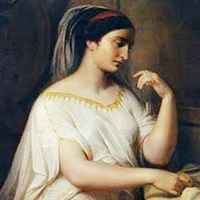
Wife to Odysseus, mother to Telemachus, and also cousin to Helen and Clytemnestra. She is famously a devoted, classy wife, but in The Odyssey she shows some serious Silk Hiding Steel material while dealing with a bunch of crass, greedy suitors who want to fill the power void left by her husband, while the poor guy is not even officially dead.