Seon-nyeo / No. 044 MBTI 성격 유형

인격
"Seon-nyeo / No. 044은 어떤 성격 유형입니까? Seon-nyeo / No. 044은 mbti의 ESTJ 성격 유형입니다. enneagram의 2w3 - SO2 - 287, big 5의 SLOEI, socionics의 EIE입니다."
𝐊𝐚𝐫𝐦𝐚, 𝐚𝐬 𝐚 𝐜𝐨𝐧𝐜𝐞𝐩𝐭, 𝐢𝐬 𝐟𝐮𝐧𝐝𝐚𝐦𝐞𝐧𝐭𝐚𝐥𝐥𝐲 𝐒𝐢-𝐜𝐨𝐝𝐞𝐝. In his original writings, Jung described introverted sensation as follows: “It makes a definite psychic impression, since elements of a higher psychic order are perceptible to it. This order, however, does not coincide with the contents of consciousness. It is concerned with presuppositions, or dispositions of the collective unconscious, with mythological images, with primal possibilities of ideas.” That is, even before any judging functions are invoked, Si predisposes the individual to a "psychological precondition", an internal sense of order that must be maintained. This internal order may not be conscious, but it is deeply felt, like a baseline state that, when disturbed, prompts an almost instinctual movement back toward equilibrium. You can think of Si as an internal mechanism of restoration, a way of returning to baseline after disturbance. An analogy would be a scale: on one side is the Si user, on the other is the world. The goal is always to maintain balance. Jung himself wrote: “The too-low is raised a little, the too-high is made a little lower; the enthusiastic is damped, the extravagant restrained; and the unusual brought within the ‘correct’ formula: all this in order to keep the influence of the object within the necessary bounds.” This is not so much about external control as it is about protecting an internal psychological condition that feels correct. Taking a step back would eventually require steps forward again. Disruptions need to be balanced over time, returning to their internal sense of order. When this mechanism is in the first or third position, Jung’s own description holds remarkably true: “Such men allow themselves to be abused, for which they usually take vengeance at the most unsuitable occasions with redoubled stubbornness and resistance.” Harm may be tolerated in the moment, but it creates an internal imbalance that demands eventual redress. The scales must be set right. However, when Si sits in the auxiliary position, the first clause (“such men allow themselves to be abused”) is not as apparent. The auxiliary function is a tool one can turn on and off at will as it is more consciously accessible and creatively applied. Where dominant Si is bound to its own rhythm, auxiliary Si can be used strategically. This is why Si-aux users often appear fascinated by concepts like karma as a lived dynamic of balance and restoration. Consider Buba (ESTJ) from How to Sell Drugs Online (Fast). In the film about him, he literally keeps a notebook where he records every bad thing that happens to him, believing that if he hurts himself, good things will follow. Or take Taylor Swift (ESFJ), whose recurring themes of betrayal, vindication, and cosmic justice carry the same flavour, the sense that things must eventually balance out, that wrongs will be righted and the scales will tip back in her favour. This is the Si-aux’s version of power. Unlike Se users, who engage with the external environment directly and immediately, the Si user lets pressure settle, layer by layer like sediment, and strikes only once the balance is sufficiently skewed in their favour. You could even say that Se bullies have a kind of “bully code,” wherein they won’t kick you while you’re down, whereas Si-aux bullies wait for you to be completely powerless, so they can crush you in a way that feels earned. Look at what happens when Player 44 finds the protagonist chained to the bunk beds. She gives a whole monologue about how he got what he deserved, how the scales have finally balanced. That’s karma, framed through an Si–Ne lens. But the irony is, she lacks Ni. So while she’s obsessed with restoring her sense of moral equilibrium, she’s completely blind to cause and effect (Ni) in the external world (Se). She doesn’t even seem to register that provoking someone who’s already in a mood as low as the protagonist (Fe demon) might end badly for her (getting choked). For Player 44, the immediate physical world is trumped by her own internal sense of order (Si).
전기
The shaman participant.
인격 correlate
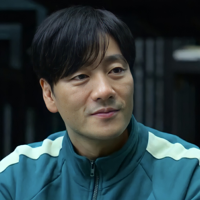
Cho Sang-woo / No. 218

Choi Su-bong "Thanos" / No. 230
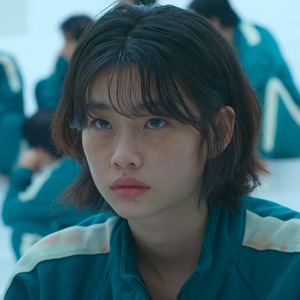
Kang Sae-byeok / No. 067

Seong Gi-hun / No. 456

Ali Abdul / No. 199

Nam-gyu / No. 124
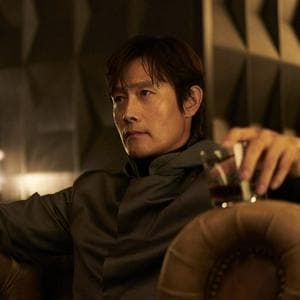
Hwang In-ho / No. 001 / Frontman

Lee Myung-gi "MG Coin" / No. 333