Emperor Shun(舜/姚重华) tipo de personalidade mbti
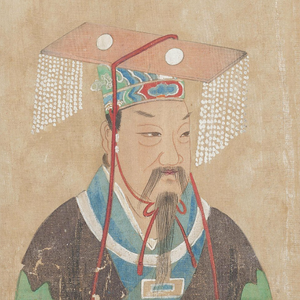
Personalidade
"¿Qué tipo de personalidad es Emperor Shun(舜/姚重华)? Emperor Shun(舜/姚重华) es un tipo de personalidad en mbti, 1w2 - - en enneagram, en Big 5, en Socionics."
Biografia
Emperor Shun (Chinese: 帝舜; pinyin: Dì Shùn) was a legendary leader of ancient China, regarded by some sources as one of the Three Sovereigns and Five Emperors being the last of the Five Emperors. Tradition holds that he lived sometime between 2294 BC and 2184 BC. Tradition also holds that those with the surname Hu (胡) are descendants of Emperor Shun. The Duke Hu of Chen, 胡公滿, a descendant of Shun, became the founder of the State of Chen. Later Chen dynasty emperors such as Chen Baxian would also claim descent from Shun. Names Shun's clan name (姓) is Yao (姚), his lineage name (氏) is Youyu (有虞). His given name was Chonghua (重華). Shun is sometimes referred to as the Great Shun (大舜) or as Yu Shun or Shun of Yu (虞舜), "Yu" being the name of his fief, which he received from Yao. Life of Shun According to traditional sources, Shun received the mantle of leadership from Emperor Yao at the age of 53, and then died at the age of 100 years. Before his death Shun is recorded as relinquishing his seat of power to Yu (禹), the founder of the Xia dynasty. Shun's capital was located in Puban (蒲阪), presently located in Shanxi). Under Emperor Yao, Shun was appointed successively Minister of Instruction, General Regulator and chief of the Four Peaks, and put all affairs in proper order within three years.Yao was so impressed that he appointed Shun as his successor to the throne. Shun wished to decline in favour of someone more virtuous, but eventually assumed Yao's duties.It was said that "those who had to try a lawsuit did not go to Danzhu, but to Shun." Danzhu was the son of Yao. After ascending to the throne, Shun offered sacrifices to the god Shang Di (上帝), as well as to the hills, rivers, and the host of spirits (神).Then he toured the eastern, the southern, the western, and the northern parts of the country; in each place he offered burnt-offering to Heaven at each of the four peaks (Mount Tai, Mount Huang, Mount Hua and Mount Heng), sacrificed to the hills and rivers, set in accord the seasons, months, and days, established uniform measurements of length and capacities, and reinforced ceremonial laws. Shun divided the land into twelve provinces, raising altars upon twelve hills, and deepening the rivers. Shun dealt with Four Perils: banishing Gonggong to You Prefecture, confining Huan-dou (驩兜) on Mount Chong (宗山), executing or imprisoning Gun a prisoner till his death on Feather Mountain (羽), and driving the San-Miao into San-Wei. Gun's son, Yu (禹), was subsequently appointed as minister of work(共工) to govern the water and the land.Later, Shun appointed Yu to be General Regulator (Prime Minister). Yu wished to decline in favour of the Minister of Agriculture, or Xie (契), or Gao Yao, but finally accepted upon Shun's insistence.Shun then appointed Chui (垂) as the new minister of work (共工).Shun also appointed Yi as Minister of Animal Husbandry to govern the beasts and trees of the land,Bo-yi as Priest of the Ancestral Temple to perform religious ceremonies,Hui as Director of Music,Long as Minister of Communications to counter deceptions and false reports. According to the Canon of Shun, Shun began to reign at the age of 30, reigned with Yao for 30 years, and reigned 50 more years after Yao's abdication, then Shun died. The Bamboo Annals state that Yao chose Shun as his heir three years before abdicating the throne to him. Both sources agree that after abdicating, Yao lived for another 28 years in retirement during Shun's reign. In later centuries, Yao and Shun were glorified for their virtue by Confucian philosophers. Shun was particularly renowned for his modesty and filial piety (xiao 孝).


